When a component moves beyond simple mechanical features, the machining process itself becomes a critical engineering decision. A part with deep pockets, curved surfaces, angled holes, or multiple precision features may require a completely different manufacturing approach compared with a standard machined component.
Many manufacturers still rely on 3-axis machining because it offers excellent reliability, straightforward programming, and cost efficiency for conventional parts. However, as product designs become more compact and complex, limitations related to tool access, repeated setups, and feature alignment become increasingly important.
5-axis CNC machining provides a solution for these challenges by allowing additional rotational movement between the cutting tool and the workpiece. Instead of relying on multiple repositioning operations, manufacturers can machine complex geometries from optimized angles while maintaining better control over cutting conditions.
The decision between 5-axis and 3-axis machining should not be based only on equipment capability. The right choice depends on the relationship between part design, material properties, tolerance requirements, surface finish expectations, and production objectives.
At HKBOSTEC, machining strategies are developed through engineering evaluation rather than selecting the most advanced technology by default. By analyzing the complete manufacturing requirement, HKBOSTEC helps customers determine the most effective approach for producing accurate and reliable precision components.
A component may appear simple during the design stage but become challenging during manufacturing due to accessibility limitations.
The main issues usually involve:
Multiple machining orientations
Difficult tool approach angles
Tight positional relationships
Complex curved surfaces
High consistency requirements
For example, a component containing several angled holes and curved surfaces may require multiple setups on a traditional three-axis machine. Although each individual operation can be completed accurately, maintaining the relationship between all features becomes more difficult after repeated repositioning.
This is where machining strategy directly affects final part performance.
3-axis machining remains one of the most commonly used CNC manufacturing methods.
The machine controls movement along:
X-axis
Y-axis
Z-axis
The cutting tool removes material while moving in these three directions, making it highly effective for many standard components.
Typical 3-axis applications include:
| Component Type | Common Features |
|---|---|
| Mechanical plates | Holes, slots, pockets |
| Housings | Basic cavities and mounting features |
| Fixtures | Flat surfaces and standard geometry |
| Brackets | Simple angled features |
However, complex components often introduce challenges that exceed the practical capability of three-axis machining.
When a part requires machining from different directions, three-axis machining usually requires several setups.
The process may involve:
Initial fixture installation
First machining operation
Component repositioning
New alignment verification
Additional machining operations
Every repositioning step introduces potential variation.
Possible effects include:
Datum alignment errors
Longer production time
Increased inspection requirements
Higher labor involvement
For components where multiple features must maintain precise relationships, reducing setup operations can significantly improve consistency.
5-axis CNC machining combines three linear movements with two rotational movements, allowing the cutting tool or workpiece to change orientation during machining.
This additional flexibility enables manufacturers to:
Access difficult features
Reduce fixture changes
Improve tool positioning
Machine complex surfaces more efficiently
HKBOSTEC provides advanced 5 axis CNC machining services for components requiring complex geometries, accurate multi-angle machining, and improved production efficiency.
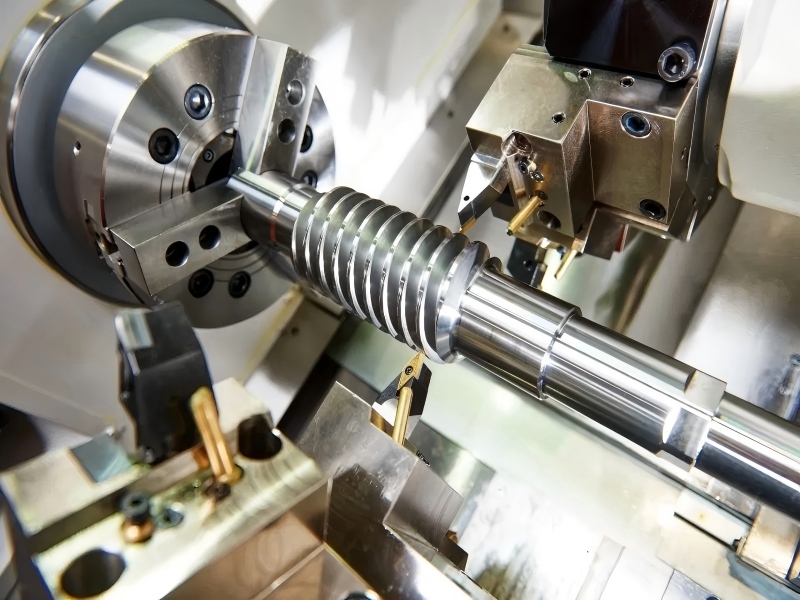
The ability to adjust tool orientation is one of the most important advantages of five-axis machining.
Compared with fixed three-axis movement, five-axis technology allows better access to:
Deep cavities
Angled surfaces
Complex intersections
Internal features
This reduces the need for additional fixtures and secondary operations.
A major advantage of five-axis machining is completing more operations within a single setup.
This helps maintain:
Feature alignment
Dimensional consistency
Repeatability
For precision components, reducing handling can be as important as improving cutting speed.
Surface quality depends heavily on the relationship between the cutting tool and the workpiece.
When machining curved surfaces with three-axis methods, the tool angle may constantly become less favorable.
Five-axis machining allows continuous adjustment of tool orientation, helping maintain:
More stable cutting conditions
Better surface consistency
Reduced tool stress
This is especially valuable for aerospace, medical, and tooling applications.
The cost difference between 5-axis and 3-axis machining should be evaluated from the entire production process rather than the machine price alone.
A three-axis machine generally requires lower programming complexity and has a simpler operating process. For parts with straightforward geometry, this often makes it an efficient and economical solution.
However, complex components may require several machining stages when produced with three-axis equipment. Additional setups, fixture changes, and alignment procedures can increase overall manufacturing time and introduce more opportunities for dimensional variation.
Five-axis machining typically requires greater investment in equipment, programming, and process planning. However, for components with complex geometries, the ability to complete multiple operations in fewer setups can improve overall production efficiency.
The actual cost advantage depends on factors such as:
Part complexity
Production quantity
Material difficulty
Tolerance requirements
Number of required setups
Inspection requirements
A higher-level machining capability does not automatically mean higher manufacturing cost. For the right application, five-axis machining can reduce total production effort by simplifying the manufacturing process.
Five-axis machining provides the greatest value when a component contains features that would otherwise require multiple operations.
Typical examples include:
Aerospace structural components
Medical implants
Complex tooling inserts
Precision industrial components
For these parts, five-axis machining can reduce:
Manual repositioning
Fixture changes
Alignment adjustments
Secondary machining operations
This creates a more controlled manufacturing process and improves repeatability.
Material characteristics directly affect machining strategy.
A process that works efficiently for aluminum may not be suitable for titanium or hardened alloys.
Aluminum is widely used because of its excellent machinability.
Three-axis machining is often suitable for:
Mechanical housings
Plates
Brackets
General structural components
However, five-axis machining becomes valuable when aluminum parts include:
Complex weight-reduction structures
Curved surfaces
Multiple angled features
Titanium alloys are widely used in aerospace and medical applications because of their high strength-to-weight ratio.
However, machining titanium requires careful control because of:
Low thermal conductivity
High cutting temperature
Tool wear concerns
Five-axis machining can improve titanium processing by maintaining more consistent tool engagement and reducing unnecessary cutting stress.
Hardened steels are commonly used for:
Molds
Dies
Precision tooling
When these components contain complex profiles or difficult-to-access features, five-axis machining can provide better flexibility compared with conventional machining methods.
Although five-axis machining provides advanced capability, traditional CNC milling remains an important manufacturing solution.
Not every complex-looking component requires five-axis processing.
CNC milling can still be the preferred option when:
Features are accessible from standard directions
The component does not require continuous contour machining
Production efficiency is the main priority
Cost optimization is important
HKBOSTEC provides professional CNC milling services for precision components requiring reliable accuracy, repeatable production, and efficient machining solutions.
The best manufacturing strategy often combines different machining technologies rather than relying on one process for every application.
Successful production of complex components requires more than advanced machine tools.
A complete machining solution depends on:
Engineering analysis
Process planning
Tool selection
Machining parameter optimization
Dimensional inspection
At HKBOSTEC, engineers evaluate each project according to:
| Evaluation Factor | Manufacturing Consideration |
|---|---|
| Part geometry | Required machining directions and accessibility |
| Material | Cutting conditions and tool requirements |
| Tolerance | Required dimensional control |
| Surface finish | Final functional requirements |
| Production volume | Efficiency and process selection |
This engineering-based approach helps determine whether a project requires:
3-axis machining
5-axis machining
A combination of multiple processes
Complex parts require consistent control throughout the entire manufacturing process.
A capable precision machining partner should understand:
Design requirements
Manufacturing limitations
Inspection expectations
Application requirements
HKBOSTEC delivers integrated precision machining services for customers requiring accurate components with demanding specifications.
By combining machining expertise with quality control procedures, HKBOSTEC supports industries where precision, repeatability, and reliability are essential.
Before selecting a machining method, engineers should consider:
| Question | Manufacturing Impact |
|---|---|
| Does the part require multiple machining angles? | Determines whether additional axes provide value |
| Are there complex curved surfaces? | May require continuous tool movement |
| Are feature relationships critical? | Fewer setups may improve consistency |
| Is production volume high? | Influences process economics |
| Does the material create machining challenges? | Affects tool orientation requirements |
A careful evaluation prevents unnecessary manufacturing complexity while ensuring the selected process meets performance requirements.
The main difference is the additional rotational movement available in five-axis machining. This allows the cutting tool to approach the workpiece from multiple angles, while three-axis machining relies mainly on fixed linear movement.
Not necessarily. Accuracy depends on machine capability, programming quality, material behavior, and inspection processes. Five-axis machining can improve consistency by reducing setups for complex parts.
Aerospace components frequently contain complex curved surfaces, lightweight structures, and strict dimensional requirements. Five-axis machining provides the flexibility needed to manufacture these geometries efficiently.
No. Three-axis machining remains an effective solution for many components. The correct choice depends on part requirements rather than technology level alone.
For complex parts, five-axis machining can reduce production time by minimizing setups and repositioning operations. The actual improvement depends on component design and manufacturing strategy.
HKBOSTEC evaluates part geometry, materials, tolerances, surface requirements, and production goals before recommending a machining approach that balances quality, efficiency, and cost.
5-axis CNC machining and 3-axis machining each provide important advantages in modern manufacturing. Three-axis machining remains a practical solution for components with accessible features and straightforward geometries, while five-axis machining provides greater flexibility for complex parts requiring multiple machining orientations.
The key consideration is not whether five-axis technology is more advanced, but whether its additional capability solves a specific manufacturing challenge. For components with complex surfaces, tight feature relationships, and difficult tool access, five-axis machining can provide significant benefits through reduced setups and improved process consistency.
For simpler components, three-axis machining may continue to offer the most efficient balance between accuracy and cost.
By combining engineering expertise, advanced machining technology, and quality-focused production processes, HKBOSTEC helps customers develop precision components that meet demanding industrial requirements.
This is the first one.